A low pulse does not automatically mean you need a pacemaker. By examining the rhythm pattern, related symptoms, reversible causes and risk of dangerous pauses, you can understand why a cardiologist may recommend observation, medication changes, monitoring or permanent pacing.
Key takeaways
- Match fainting, fatigue or poor exercise tolerance with documented rhythm abnormalities.
- Review medicines and reversible causes before deciding on permanent pacing.
- Choose the pacemaker system according to the conduction problem and pacing needs.
- Keep scheduled checks after implantation to monitor the device, leads and heart rhythm.
Which heart rhythm problems can justify a pacemaker?
Permanent pacing is supported by symptomatic sinus bradycardia, sinus node dysfunction, chronotropic incompetence, acquired Mobitz type II block, high-grade atrioventricular block, complete heart block and alternating bundle-branch block. Symptoms can include fainting, near-fainting, dizziness, unusual fatigue or poor exercise tolerance when they match the documented rhythm.
| Rhythm finding | What it means for pacing | Key qualification |
|---|---|---|
| Symptomatic sinus bradycardia or sinus node dysfunction | Can support a pacemaker | Link symptoms to the slow rhythm |
| Acquired Mobitz type II, high-grade AV block or complete heart block | Often supports permanent pacing, even without symptoms | Exclude reversible or physiological causes |
| First-degree AV block, Mobitz type I or an isolated low pulse | Does not automatically require a device | Consider pacing only in selected cases, such as clear symptom correlation or severe conduction disease |
Acquired high-grade AV block and complete heart block can justify pacing without symptoms when medication effects, electrolyte abnormalities, infection, ischaemia or increased vagal tone do not explain them. That distinction matters in a complete heart block treatment decision.
Atrial fibrillation alone is not a pacemaker indication. Pacing may enter the decision when it produces symptomatic slow ventricular rates, significant pauses or important AV block; stroke prevention and rate control remain separate decisions. An ICD, rather than a pacemaker, is used for selected risks involving ventricular tachycardia or ventricular fibrillation.
How do symptoms and tests show that a slow rhythm is the problem?
Clinicians attribute symptoms to bradycardia only when the timing of the complaint matches a documented slow rhythm or pause. A low pulse by itself does not explain fainting, dizziness or fatigue.
Symptoms that can support pacing include:
- Fainting or near-fainting
- Dizziness or confusion
- Marked fatigue
- Breathlessness during exertion
- Poor exercise tolerance
Tests provide the missing timing evidence:
- A 12-lead ECG identifies persistent bradycardia and conduction patterns, such as an atrioventricular block.
- Holter monitoring records the rhythm continuously for a shorter period, making it useful when symptoms occur frequently.
- A longer patch monitor or event monitor improves the chance of capturing an infrequent episode.
Symptom-rhythm correlation is the key finding: the symptom and the slow rhythm must occur together. If dizziness occurs while the rhythm is normal, bradycardia is unlikely to be the cause.
Sinus-node dysfunction has no single heart-rate cutoff or pause duration that automatically requires pacing. Clinicians weigh the rhythm type, duration, pause risk and symptom severity instead. Vague tiredness or an occasional low reading without recorded correlation should not be treated as proof.
Echocardiography is added when structural heart disease is suspected. An electrophysiological study is reserved for selected cases in which non-invasive testing leaves the cause uncertain.
What should be treated or reviewed before implantation?
A slow pulse does not by itself justify a pacemaker. Doctors first look for reversible causes of bradycardia, because treating them can restore a safer heart rate and prevent premature implantation.
- Review rate-slowing medicines, including beta-blockers, verapamil, diltiazem and digoxin. Do not stop any of these abruptly without medical advice; supervised dose adjustment or substitution may be enough.
- Order blood tests and assess the clinical picture for hypothyroidism, low or high potassium and other electrolyte abnormalities, infection, and myocardial ischaemia.
- Consider increased vagal tone, including a physiological response during appropriate circumstances such as sleep, vomiting or strenuous activity. Observation can be safer than implantation when this explains the slow rate.
- Investigate suspected sleep apnoea. Sleep-related sinus bradycardia or pauses alone do not justify permanent pacing; treating obstructive sleep apnoea can reduce nocturnal rhythm abnormalities.
A single low reading from a home monitor or smartwatch cannot establish a pacing indication. These devices can misread irregular beats, lose contact or record a brief physiological slowing. Clinicians instead use examination, ECG and appropriate monitoring to confirm the rhythm and relate it to symptoms.
If an underlying illness, medication effect or sleep disorder explains the finding, correcting that problem comes before deciding on a device.
Which pacemaker system and implantation approach fit the heart problem?
The heart problem determines the device: rhythm pattern, atrial activity, venous and cardiac anatomy, and future pacing needs all matter.
| Option | What it provides | When it may fit |
|---|---|---|
| Conventional transvenous single-chamber pacemaker | One lead supports one chamber | Selected patients who need pacing in one chamber |
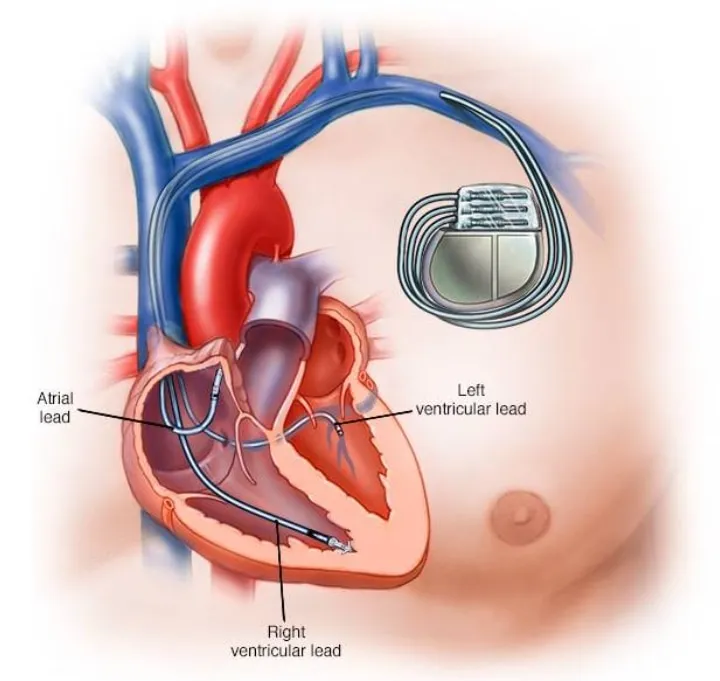
| Conventional transvenous dual-chamber pacemaker | Separate atrial and ventricular leads can preserve coordination | Useful when atrial activity and anatomy support atrioventricular synchrony |
| Leadless pacemaker | A catheter-delivered device avoids a chest pocket and transvenous lead | Selected patients whose rhythm and anatomy suit its more limited pacing configurations |
| Cardiac resynchronization therapy | Coordinates ventricular contraction through multiple leads | Selected patients with heart failure and electrical dyssynchrony, not routine slow-pulse treatment |
For a conventional system, the clinician uses local anaesthetic with sedation, makes an incision below the collarbone, passes the lead or leads through a vein into the heart, tests sensing and pacing, closes the incision and observes you afterward.
A leadless pacemaker travels through a vein on a catheter and is secured inside the heart instead.
Healing instructions vary with the device and operator. You may be told to limit strenuous arm movement or heavy lifting while the incision and leads settle; follow the specific restrictions given to you rather than assuming a fixed recovery timeline.
The Heart Clinic - Dr. Satyajeet - 08048066834 can help review ECG and monitoring findings, symptoms, anatomy and pacing goals before you compare device options in Pune.
Related service
Pacemaker Implantation A pacemaker insertion is the implantation of a small electronic device that is usually placed in the chest (just below the collarbone) to help... View service → |
What risks and follow-up decisions remain after a pacemaker is placed?
Implantation is a treatment decision, not the end of assessment. Recognised pacemaker complications include:
- Bleeding or a haematoma around the generator pocket
- Infection of the wound, pocket or leads
- Lead displacement or lead malfunction
- Pneumothorax from vein or chest access
- Rare cardiac perforation
Pacemaker follow-up checks battery status, lead function, programmed settings and whether pacing remains necessary. Remote monitoring can alert the care team to device or rhythm changes, but it does not replace scheduled reviews. Report fainting, wound redness or discharge, palpitations, or new breathlessness promptly.
An MRI is not automatically prohibited. Confirm that the exact generator-and-lead combination is an MRI-conditional pacemaker, then follow the manufacturer’s conditions for scanner strength, device programming and monitoring; older or mismatched systems need a separate risk assessment.
Some people become pacing-dependent because conduction disease persists, while others have intermittent or reversible problems, so clinicians must reassess the original indication rather than infer it from the device alone. A pacemaker prevents excessively slow rates; it does not treat every cause of fainting, coronary artery disease or fast ventricular rhythms.
An implantable cardioverter-defibrillator addresses selected fast-rhythm risks instead.
Frequently asked questions
Which heart rhythm problems can justify a pacemaker?
Permanent pacing can be justified by symptomatic sinus bradycardia, sinus node dysfunction, chronotropic incompetence, acquired Mobitz type II block, high-grade atrioventricular block, complete heart block and alternating bundle-branch block.
How do doctors show that a slow rhythm causes symptoms?
Doctors compare symptoms such as fainting, near-fainting, dizziness, unusual fatigue or poor exercise tolerance with ECG, ambulatory monitoring and other test results documenting the rhythm.
What should be reviewed before pacemaker implantation?
Review medicines and reversible causes of bradycardia before implantation, then confirm that the symptoms and documented rhythm support permanent pacing.
How is the right pacemaker system selected?
The system and implantation approach depend on the heart problem, including whether the issue involves sinus-node function, atrioventricular conduction or a need for coordinated chamber pacing.
What follow-up is needed after a pacemaker is placed?
Follow-up checks assess device function, lead performance, battery status, programmed settings and any ongoing symptoms or complications.